Categories
Teardowns

Product Teardown: Monarch Money

A teardown sounds bad. Malicious even. Images come to mind of a well-researched exposé inflicting irreparable reputational harm. Or at least a conspiracy theorist doing conspiracy theory things.

Maybe that’s some kind of teardown, but not this kind. This kind isn’t negative, or at least maliciously so.

Rather, the goal is to take the view of a user and unpack the product and design choices the developer made in building a software experience.

What messages do they want prospective users to see? What information do they require to sign-up? Do they offer a free trial, and if so, how long? What features do they steer me toward in-app? Like a tree, every answer branches off in a new direction, leading to another layer of questions.

…Which brings me to today.

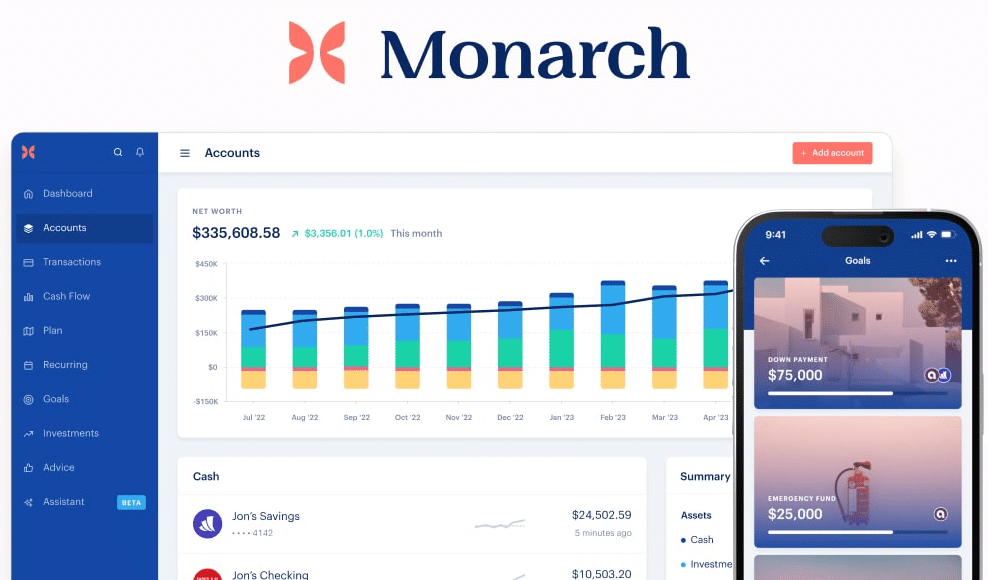
This is the first in a series of fresh-eyed deep dives into tech products I try and use. Today I’ll focus on the sign-up and onboarding flows for Monarch Money, a personal finance app for tracking net worth, budgeting, and getting a “complete picture of your finances”.

Context: My background and research

A bit about my mindset going in: I’ve been a personal finance nerd for as long as I can remember, so having a live dashboard of all money-in and money-out is a longtime goal. I’ve spent more time than I care to admit researching and comparing credit card benefits. I’ve built spreadsheets to track and project income, expenses, and net worth. And I’ve used and enjoyed free apps like Personal Capital (AKA Empower) and Mint over the years. But with these apps, I never felt our incentives were perfectly aligned: since they were free, I was the product, or so the narrative goes. 

So with this long-held interest and a healthy skepticism of free software, I was thrilled to see subscription-based finance apps gain traction in 2023 and onwards.

Monarch. Copilot. You Need A Budget. Simplifi. Rocket Money. The visions are often similar: for a job as important as your finances, you’re better off paying with your wallet than paying the indirect costs of using free software.

Most of these paid offerings were priced in the range of $100 per year, which I’d gladly pay for a solution that fit my needs. But what exactly would this require?

In a great personal finance app, I’m mainly looking for an accurate, up-to-date view of my net worth, integrated with each of my accounts — checking, savings, brokerage, etc — in a robust way that doesn’t require constant maintenance to keep them connected. With other apps like Personal Capital, it felt like every time I opened the app I needed to reconnect a credit card or 401k account that had gone stale. Eventually, even opening the app feels like a chore.

Secondary benefits include the ability to view and categorize transactions (though I don’t do this today) and see summary views of my finances at the monthly and yearly level.

So then why Monarch?

After some light research, I narrowed the list down to Monarch Money and Copilot. While there were many great alternatives, these two seemed more attuned to ‘at-a-glance’ net worth tracking than transaction-level budgeting, which aligned better with my goals and tolerance for hassle. From there, it was close:

  • Monarch and Copilot both were highly usable and simple to setup
  • Based on several ‘best-of’ lists like this, both were leaders in this emerging category of paid-personal-finance apps.
  • Both made similar promises in their marketing: view your net worth, manage a budget, and take control of your financial future.
  • And strangely enough, they had nearly identical reviews in the iOS app store when I was deciding – 4.9 stars from ~9,000 reviews (Monarch has since grown faster over the last year).

So it was close. But a few friends I trusted were already using Monarch, and I liked its branding and UI. It felt lighter, friendlier, more approachable. 

What sold me was that Monarch hyped up its account integration and connectivity, one of my few must-haves. In fact, the primary two decision factors I considered were connectivity and price. Monarch checked each of these boxes, had great reviews, and a clean user experience. I decided to give it a go.

So with a decision made, let’s teardown their sign-up and onboarding. 

Sign-up Flow

We start at the sign-up screen, where Monarch presents a carousel with 5 value props.

  1. “See all your money in one place” – love it. The one feature I need. The subhead “giving you a complete picture of your finances” resonates well and is exactly what I’m looking for.
  2. “Make the most of your cash flow” – Analyzing our monthly spending and saving habits isn’t the reason I’m trying the app, but it’s something I may explore later. I’d like to better track our monthly spending, but manually categorizing every transaction is too much hassle. I’m curious (though skeptical) of how accurately Monarch’s AI can categorize things automatically.
  3. “See into your financial future” – new and intriguing; not something I’d thought about previously. I like the promise of setting financial goals and planning our finances to ladder up to those goals. Making a mental note to check this out another time.
  4. “Keep the big picture in view” – As a first-time reader, this language doesn’t resonate and sounds too similar to the prior value prop. Here: “Track your goals and create a budget to achieve them“, vs on slide #3 “Use Monarch to predict when you’ll hit your goals, and see how changes to your budget affect your finances over time.” I’m frankly not sure what the difference is. Instead, I would have appreciated a slide on account connectivity.
  5. “No ads, always private and secure” — this is important to me. With free finance apps, I always assumed the worst: that my data was being sold to the highest bidder. I’d rather pay a subscription for a great UX than see ads for affiliate offers or financial managers. And with data as sensitive as finances, I’m willing to pay for better data security. Maybe this slide could even go a step further and directly assert that Monarch’s incentives are aligned with mine for this very reason.

Sign up with email.

I tap the big orange button and move forward without issues. But I’m also surprised I can’t sign up with a phone number. It’s so much faster to get a verification code text and have iOS auto-populate it. For a mobile-first app in today’s age, I’ve come to expect that.

However, the email code at least arrives quickly. The small things matter.

What brings you to Monarch?

After email verification, we’ve got a pretty standard ‘get-to-know-me’ onboarding flow. 

The first item “view all of my finances in one place” is exactly what I want to do. I check that along with “Manage my money with a partner” and “track my investments“. The ‘partner’ item is especially intriguing; I assumed my wife and I would share a single login, but if Monarch has features tailored toward couples with shared finances, even better.

As a Product Manager, I like that tapping “something else” lets me type in free text so Monarch can better understand other jobs-to-be-done that users might expect from the app and thus inform the product roadmap.

How did you hear about Monarch?

Here, Monarch follows logic that Opal and others have popularized: the best way to find out how acquisition efforts are performing is just to ask [1]. I select “article or blog” and moved on.

Tell us about yourself

Pretty standard information to request, but the order of operations is well done. I like that Monarch asks about my financial priorities before this “Tell us about yourself” form; I now feel more invested and likely to move forward.

How your free trial works

This is my favorite screen in the whole onboarding flow.

Monarch is following the Blinkist playbook (among many others) of showing a maximally-clear visual timeline of the free trial, including a reminder email to reduce the fear of a rogue subscription charging me without my knowledge. For me, this goes a long way to build trust. And I like the top banner carousel that rotates between “Featured in X” and “4.8 stars” to drive home the message that this is THE personal finance app I want.

However, I definitely want to use the Mint switcher promo code, and I don’t see any field to enter it. I’m not sure if this is purposefully hidden, but it’s a blocker. So I pause at this screen.

At this stage, Monarch confuses me. I receive an email saying “Thanks for joining us!” and “Welcome to your Monarch trial!“. I haven’t started the trial yet, so I double check in iOS Settings that I didn’t accidentally subscribe. Not great.

Now confused, I ditch the phone and open my laptop. Once I log in via the browser, and click on a marketing CTA featuring the promo code, Monarch takes me to subscription check-out and pre-applies the promo code. I’m through, but I can imagine some percentage of users quitting here in frustration.

Onboarding & Account Connection

After subscribing with the promo code, I switch back to the iOS app. 

Since I didn’t categorize or monitor my transactions on Mint, I forgo importing Mint data via spreadsheet and instead manually add accounts. However, I like that importing is an option, and I wonder how effective it is.

The only available action is “Add account“; everything else is locked. I appreciate how direct Monarch is here to nudge me along the intended flow. Why even allow the user to venture anywhere else if there’s no data to view yet?

First, I try to add our checking account. The flow seems easy, and I like that Monarch touts backup connection methods if the primary method fails. 

Despite this perception, I go 0 / 2 on connecting my checking & brokerage accounts. It’s frustrating, and I’m now questioning the effectiveness of the purported backup methods.

I’m not sure what changed, but a few attempts later Monarch successfully connects to both my checking account and brokerage account. The flow is fast and easy when successful, using Plaid, Finicity, and other connection tools to access account data. And the brief animation (below) drives home this celebratory message, a well-placed touch of gamification.

From here, I keep at it and connect 16 accounts: checking, brokerage, 401ks, HSA, credit cards, student loan, and others.

This takes an hour between fetching login information, doing two-factor authentication, and several false starts. But rather than faulting Monarch, I think this highlights how disjointed our digital selves are. You’d think a cross-internet, immutable digital ID would have become the norm a decade ago, yet most of us still tape together dozens of usernames, passwords, verification codes, and security questions into a digital identity, which makes aggregation a pain.

Takeaways

That’s it for Monarch’s sign-up and onboarding, though I may share more about long-term use in a follow-up post.

A few months in, I’m impressed by Monarch and plan to keep the subscription.

The signup flow was fast and easy. Each screen and requested field had a purpose and there wasn’t much excess friction in the flow.

I also love that Monarch has several methods of connecting to each account to minimize disruptions. Over several months of use, only one account gets disconnected, and I blame that more on the account provider than Monarch. Most weeks I can open the app once, click “Refresh all”, and within a minute see exactly where we sit.

The UI is simple and clean while still packing a variety of features — long term goals, recurring expense tracking, monthly reviews, budgets, categories — most of which I still have yet to explore. Lots to learn here!

And most importantly, I feel our incentives are aligned. Neither my inbox nor mailbox are stuffed full of credit card offers; I haven’t gotten calls from financial managers contracting with Monarch, and (to my knowledge) my transaction-level data is secure.

Lessons learned:

  • Every brand interaction is an opportunity: Software customers are won and lost for reasons that aren’t always clear to the developer, and sometimes even to the customer. I still can’t fully articulate why I first tried Monarch over Copilot or other apps, meaning that every interaction with the brand and product is significant. As a product manager, this makes clear the importance of spending deep time in our own products to understand the holistic, end-to-end experience instead of getting caught up in launching individual features.
  • Transparency pays: I love how Monarch showed me a visual timeline during sign-up, with milestones denoting when the free trial ends, when I’ll be charged, and how far in advance they’ll remind me. Not only does this reduce fear and increase the chance I sign-up, but it bolsters my perception that Monarch is an honest company keeping my best interest in mind. I expect (and hope) I’ll get a similar reminder email before my Year 2 subscription charges.
  • Keep the main thing the main thing: It bears repeating that the accurate, up-to-date snapshot view is 90% of the value I derive from Monarch, which relies on proper account connectivity. Monarch does this well, I get the value I’m looking for, and as a result I’m more than happy to pay.

If you read this far, my sincere gratitude. I’d love your thoughts on Monarch broadly or reactions to this post.

And if you enjoyed this teardown and want to try Monarch yourself, you can use this referral code (also pasted below) for a 30-day free trial.

https://www.monarchmoney.com/referral/if1q3potu7

All the best,

John


Thanks to Emmet Hennessy and Payton Mills for reading drafts of this post.

Categories
Longform Essays

On Building in Public

“The curse of modernity is that we are increasingly populated by a class of people who are better at explaining than understanding, or better at explaining than doing…There is no evolution without skin in the game.” – Nassim Taleb

Skin in the Game

Too often, our society separates responsibility from accountability, reward from risk. 

In his book Skin in the Game, statistician and investor Nassim Taleb reveals the shallowness of punditry, of opinions without consequences. Financial advisors don’t follow their own portfolio guidance. Political columnists don’t win elections or implement public policies. And the only successful businesses built by many self-help hustlers are the seminars they peddle.

Their advice can be useful, but it’s not the language of the builder, the proverbial man in the arena. And as Taleb points out, “For it will always remain that action without talk supersedes talk without action.” Pundits don’t have skin in the game.

Widen the aperture and we are all pundits in various arenas. Armchair quarterbacks and wannabe-presidents with tidy ideas about how things should’ve been done. But instead of fostering a culture of critics, our society needs more operator-writers: those holding a tangible stake in the outcome of their craft and publicly sharing their lessons. They are entrepreneurs, developers, traders. Their incentives are tied to results and they have perspective that the pundit does not. Operator-writers have skin in the game.

What does this look like in practice? The derivatives trader who regularly publishes her portfolio holdings alongside the typical market forecast that’s wrong in a year anyways. The artist who produces not only paintings, but a candid peek behind the curtain of the creative process. The software engineer who tweets every milestone, from the first line of code to functioning application. 

More than any other field, entrepreneurship exemplifies skin in the game. Business operators not only make falsifiable predictions; they live them out. Taleb says “Don’t tell me what you think, tell me what’s in your portfolio” [1]. While traders simultaneously hold dozens of positions, an entrepreneur’s portfolio is often a single company. A ride or die. Business operators might place one bet in a decade, sometimes one in a lifetime. With a single basket full of eggs, successes and failures are evident, allowing budding builders to cut their teeth on the experience of others.

But while many leaders publish a memoir after making their millions, what’s more useful is the journey of the up-and-comer, a nobody becoming a somebody, a builder in the toil of building, a man in the arena.

Transparency: Real-Time and Radical

Despite the obvious risks, some entrepreneurs are sharing their experiences in real-time rather than the rear view. No one personifies this better than Joel Gascoigne and Buffer. Founded in 2010, Buffer develops a platform for social media engagement analytics, and from day one, Joel and the Buffer team embraced a radical core value: absolute transparency

This remarkable journey began in 2011 when Joel publicly released Buffer’s product roadmap, revealing their backlog of development plans. By March 2013, Joel had published all employee salaries and equity percentages. A year later, he shared the first hiring report internally: a spreadsheet of applicants, interviews, and hires. As Buffer grew over the years, their transparency was both striking and unheard of, including releases of: 

Now in the COVID pandemic, Buffer is experimenting with four-day workweeks to improve employee wellness and is characteristically publishing its findings [2]. Joel’s radical approach to transparency seeded Buffer’s rise, where they now serve over 68,000 businesses internationally and gained recognition as one of America’s best workplaces [3]. But as Joel points out, Buffer doesn’t choose transparency for performance: “transparency breeds trust, and trust is the foundation of great teamwork.”

Joel isn’t alone in discovering the benefits of sharing with a public audience. Suhail Doshi launched Mighty with the goal of building a faster Google Chrome for power users [4]. From Mighty’s inception in April 2019, Suhail has tweeted a flood of updates, from a new landing page and first pre-sale customers to a strategy pivot and Mighty’s Alpha release. Like a magician bringing the audience in on the act, Suhail’s community now provides tailored product feedback and actively roots for Mighty’s success.

This transparency led to an acceptance at the Y Combinator accelerator program where Suhail refined the product, expanded the team, and garnered further public momentum. And it all started with a tweet:

Others have different plans initially. As an early engineer at Pinterest, Sahil Lavignia itched to become an entrepreneur. Even before vesting his stock options, Sahil left to found the startup that would become a billion-dollar company, so he thought. Gumroad would allow internet creators — graphic designers, illustrators, app developers, tutors, writers, and other freelancers — to sell products with a simple link rather than a landing page, storefront, and checkout system [5].

But after raising over $8M from an elite cast of investors, Gumroad’s growth leveled off, and by Fall 2015, Sahil had to lay off 75% of his staff to stay alive. The startup had lost its shine for venture investors, and raising additional money wasn’t feasible. As the final five employees trickled off to greener pastures, Sahil debated shutting Gumroad down.

Finally, he caught a break.

When an investor bowed out of their ownership and returned their shares, Sahil slashed costs to become profitable, solving customer issues himself to continue operating as a one-person enterprise. As he wrestled with a new vision for Gumroad, Sahil began to see the impact he could have through transparency, so in April 2018, he began publicly sharing Gumroad’s metrics:

Encouraged by the warm reception to “open-sourcing” Gumroad, Sahil started quarterly board meetings that anyone could join, a practice he still employs [6]. The response has since been incredible. Although Gumroad isn’t looking to raise money, more investors than ever are offering funds, and the company now processes $175M for its creators annually [7]. 

Building in Public

What Joel, Suhail, and Sahil all have in common is the approach of building in public. Rather than hide their burgeoning companies behind a digital fortress, only lowering the drawbridge with a chic landing page and quasi-UX, each of these founders embraced transparency. They published openly, approached feedback enthusiastically, and built communities to last. 

However, building in public opens a founder to untold humiliation if things go awry. If publicly posted metrics level off, potential investors may pause. Employees may be wary to work at a company where leaders revel in the spotlight. And leaders must double down on key decisions, which increases the perceived penalty for pivoting — lest your audience wonder what went wrong.

So why risk the exposure?

Bessemer venture capitalist Gaby Goldberg points to several benefits of building in public [8]:

  • Generates hype for your product or service via a sneak peek to potential consumers, often garnering early momentum in a world saturated with new offerings
  • Enables stronger trust within your organization through open transparency to the outside world
  • Enables stronger trust outside your organization in conveying an authentic brand to users
  • Encourages users to directly engage with your strategy, tightening your feedback loop of ideas
  • Highlights an honest, visionary culture that becomes a magnet attracting future talent and investors
  • Boosts your reputation as an expert in your chosen field

More organizations should build in public. Aside from the benefits to the builder, there is obvious upside for the public:

  • Provides a mode of discovery between early adopters and small, up-and-coming products
  • Opens a channel for users to positively shape a product they use and love, especially for niche or expert markets
  • Prepares future builders with a variety of lessons: entrepreneurial strategy, raising investment, organizational management, and developing a community-centric flywheel
  • Enables the sense of a shared journey: supporters celebrate wins and sympathize with losses

In this way, the benefit to the public is equal parts utility and shared experience. The obvious benefits are practical: the apprentice learning from the master. But the second-order benefits are perhaps more interesting.

Why do we follow our favorite artist, musician, or athlete? It’s not solely skill acquisition or mimicry of craft. It’s a sense of affinity, of watching a story unfold, of experiencing history. Builders that tap into this reservoir of connection will be most successful.

Where to Next?

Now exploding in popularity, building in public may become the zeitgeist of the 2020’s. New examples abound. Take Lambda School: even before gaining market traction, the online coding school nurtured a strong and diverse online following that now celebrates milestone after milestone [9]. Since 2017, Lambda has grown from its first student cohort of 10 to its most recent of 2,900 [10].

Patrick O’Shaughnessy is another case. After growing the Invest Like the Best podcast to 200 episodes and 20M listeners, Patrick leveraged a captive audience to launch the Colossus platform in December 2020: a community and learning hub for his audience to learn in public and discover all things business and investing [11].

This pattern is now a trend. Online checkout startups are forming founding teams on Twitter [12]. Former corporate employees are finding dream roles by recruiting in public [13]. One writer is even building a town in public [14]. But while stories are circulating, the movement is in its early innings, and its potential endless.

Taking a creative or entrepreneurial risk is itself a noble pursuit: a bold, indelible step into the arena. The builder who then shares that experience — who bears skin in the game and the oft-distorted risk of public failure — makes it doubly so. Memoirs of the past are both useful and entertaining; they encompass a neatly wrapped drama, start to finish. But it’s the imperfect, open-ended story that has the most to teach.

Craft, ship, share. Build in public. 

Categories
Longform Essays

On The Metaverse: Part II

This essay is Part II of the series “On the Metaverse”. If you haven’t yet read Part I, you can check it out here.


Technological transformations like the consumer internet often arrive in stages. After a series of private networks like ARPANET were created, Tim Berners-Lee launched the World Wide Web in 1989. Internet hype skyrocketed in the late 1990’s before temporarily bottoming out in the Dot Com Crash of 2000. Web 2.0 arrived in 2004, shifting the internet from a means of communication to a platform of multimedia content.

Around 2005, social networks like Myspace and LinkedIn gained traction and at the same time, user generated content on platforms like YouTube grew so quickly that it was estimated YouTube alone consumed more bandwidth in 2007 than the entire internet in 2000 [1]. The iPhone, introduced in 2007, upended how we interact with the internet and enabled the first platforms native to mobile. Instagram was founded in 2010; Snapchat in 2011; TikTok in 2016. And alongside the growth of social and entertainment, technologies like cloud and artificial intelligence further drove (and continue to drive) the art of the possible.

The metaverse will also arrive in stages as the landscape of players, discussed in Part I, solidifies. But what’s next?

Some have cited the multiverse as an intermediate stage: a collection of walled off and independent virtual worlds [5]. In some ways, the multiverse already exists via popular but independent games like Fortnite, Roblox, and Minecraft. Either way, the next frontier for gaming is the creation of non-competitive social experiences, much like Epic Games’ Party Royale.

On the flip side, social-first companies like Facebook and Google will push further into gamification, exemplified by Facebook’s Horizon. This strategy addresses a core flaw in social networks: despite their popularity, these platforms never truly evolved into the preferred method for “hanging out”. Sure, they steal entire days of our lives. But peculiarly (and sadly), much of that time is spent passively observing, scrolling into oblivion rather than engaging and interacting with friends in real time. Social companies like Facebook want you to “hang out” on their platform ecosystem, which explains their recent app launches of Threads (for close friends) [3] and Tuned (for couples) [4].

Lastly, media-first companies also see disruption on the horizon. Though we consider social media, gaming, and video as distinct entertainment options, all draw from the same limited supply of time and attention. Disney devoted the entirety of its 2017 Board retreat to technology disruption, galvanizing the expedited launch of Disney+ and ESPN+. Moreover, Netflix’s CEO Reed Hastings sees Fortnite and other multiplayer games as Netflix’s chief competitor:

“We compete with (and lose to) Fortnite more than HBO.”

Reed Hastings // Netflix 2018 Annual Report

COVID-19 will accelerate the creation of the metaverse

The ongoing pandemic has wrought mass uncertainty for our future. The one surety? Consumers are moving to a digital-first world at a much faster pace. Before COVID-19, we were slowly increasing time spent online each year, yet current trends are revealing a step function increase. Since the pandemic started, gaming hours in the US have increased 75% [3] and Twitch streaming hours are up 83% to 5B hours in Q2 2020 [4]. This rapid change lays bare a need for better tools, for both work and play. 

Take video calling as an example. While Zoom has gained significant market share, one day of video calls will highlight still-existent problems. High bandwidth infrastructure is not pervasive, leading to video lag. There is no concept of environment persistence: a host has to set up an instance, send invites to attendees, and launch the meeting. Body language and visual cues are difficult to read. And for large meetings, it’s difficult to break into smaller groups in a natural way, like conversations at a party. After several Zoom calls, it’s evident they haven’t matched the quality of in-person gatherings. Our shift to the medium has exposed a number of flaws while increasing the prize for solving them.

Like video calling, COVID-19 has escalated the urgency of innovation in many stagnant industries. The necessity of work collaboration tools like Microsoft Teams and Google Suite has exposed gaps in seamless team communication, where files are slow to load and platforms are still buggy. The lack of sports has highlighted the need for better digital entertainment and provided a new audience on Twitch. The lack of available office space is even generating hype around better outdoor office solutions [5].

As gaps arise for new tools of work and leisure alike, necessity will dictate invention. Where there is demand, supply will rise to meet the occasion. And as we build intermediate solutions for current digital challenges, we will slowly build the metaverse.

Culture and Centrality

Aside from technological challenges, differences in industry culture may cause rifts in the merging of social and gaming for the metaverse. Silicon Valley’s agile software ethos has been well documented. Eric Ries’s The Lean Startup evangelized the concept of a minimum viable product, shipped to users as soon as possible with spartan functionality. Development teams then collect feedback and iteratively create more advanced versions while constantly communicating with users.

However, game development evolved with a different culture. Games present unique challenges compared with software or animated movies due to their inherent complexity. In his 2017 book Blood, Sweat, and Pixels, Jason Schreier documents six such challenges in game development, summarized below [7]:

  • Interactivity: Unlike movies, games do not unfold in a linear, predefined direction. Rather, rendered characters and objects must react in real time to the player’s actions, often within the bounds of varying physics and rulesets
  • Technological Pace: Technology evolves so quickly that by a game’s release, the studio is often using outdated, prior-generation tools, including both user-facing (processors, graphics cards, consoles) and development-facing (game engines, visual design)
  • Incompatible Toolkits: Developers are only as good as their software. Not only do game engines contain their own inherent bugs; they also often don’t mesh well with one another, leading to a large number of defects for complex projects
  • Scheduling Uncertainty: It’s tough to assess a game’s development progress until its graphics, controls, environment, gameplay, and story are combined. Uncertainty compounds when separate departments produce each component, often leading to release delays similar to Hollywood
  • Fun Factor: Games blend technology with art, meaning features are less important than playability. But playability can’t be accurately estimated early in development, so games often must be reworked until execution meets the creative vision

While studios test games during development, it’s rare for a studio to ship a purposefully half baked game to its fans, as is common with agile software development. As organizations native to gaming, social, and software alike compete and collaborate to build the metaverse, cultures will clash: ship-fast versus quality-first.

Second, a note on centrality. The most likely (and certainly most preferable) metaverse end state is a decentralized model, similar to the current internet. The internet contains layers upon layers of software, applications, networking, and security created by many for-profit and non-profit organizations. While platforms like Facebook and YouTube wield considerable power, no single company controls the internet or owns a majority of services. Ideally, the metaverse will be similar. It’s tempting to imagine current leaders as sole owners based on their track record. Who could beat Facebook, Google, and Microsoft to the next internet? But frequently, the large resource pools of incumbents can breed complacency. Material success in one industry leads organizations to overlook the next horizon. The metaverse will grow through old and new organizations alike.

Lastly, the metaverse as a platform is not bound to binary completion. A bridge under construction is useless; cars gain nothing by travelling halfway across the bridge and turning around. A bridge derives 100% of its value from the final plank, connecting the two sides. The metaverse, much like the internet, relies on localized completion. Intermediate and incomplete versions will still be useful. In fact, these versions will be massive upgrades from today’s technology, spurring further investment and interest much like the “incomplete” internet of the 1990’s.

Onward and Upward

As the endgame of the internet, the metaverse will usher in a golden age of communication and entertainment. We continue to shift more of our physical lives into the digital world, increasingly identifying with the personalities we build online. Instagram likes and Tiktok views are the new social currency – for better or worse – and the COVID landscape will only accelerate this shift.

Without spoiling Wade’s journey in Ready Player One, his OASIS metaverse is both a wondrous fantasy and a dystopian failure. It’s where he makes his deepest friendships and most hated enemies. And he discovers a world laden with unrest and claims to power, much like ours today. If we can glean one lesson from building the internet, it’s that technology is not fundamentally just or evil: it merely amplifies the qualities of those who wield it. Like every technology before it, the metaverse will reveal existing societal flaws and new challenges alike. Ultimately, it’s up to us to decide its fate.

Categories
Longform Essays

On the Metaverse: Part I

Wade dons his goggles and haptic gloves, then powers on the system. A loading bar flashes. After a moment, he’s whisked into a new world – vibrant and full of color. All around him, avatars of every shape and size roam about.

“My avatar materialized in front of my locker on the second floor of my high school—the exact spot where I’d been standing when I’d logged out the night before. I glanced up and down the hallway. My virtual surroundings looked almost (but not quite) real. Everything inside the OASIS was beautifully rendered in three dimensions. Unless you pulled focus and stopped to examine your surroundings more closely, it was easy to forget that everything you were seeing was computer-generated.” [1]

In Ernest Cline’s Ready Player One, readers follow Wade Watts into a radical escape from his dystopian surroundings. Stranded in a trailer park outside Oklahoma City, Wade has little hope for success in his physical life. So he turns to the OASIS: a magnificently rendered virtual universe accessed through virtual reality (VR) goggles. In this world, Wade has friends and enemies, weekly routines and weekend excursions. He attends school and earns digital currency through work. And he identifies more with his digital avatar than his physical self. In the absence of a world worth living in, Wade and millions of others turn to the OASIS for freedom.

The OASIS that Wade traverses in Ready Player One is a creative portrayal of the metaverse. While the OASIS itself is fiction, the metaverse is quickly becoming real. We are barreling towards a new state of connectivity where we increasingly identify with our virtual lives. This future lies beyond video calls and social media. It will be spatial, interactive, gamified. More friendly, yet less obsessed with friend requests. At some point in this evolution, we’ll call it the metaverse. Its implications will touch every facet of society.

So what is the metaverse?

Defining the metaverse is hard. The term was first coined in Neal Stephenson’s 1992 novel Snow Crash, describing a virtual urban world where users would “goggle in” to socialize or conduct business. Since then, many authors have created interpretations of the metaverse, including Ready Player One’s OASIS described above.

Like predicting the internet’s growth in its infancy, it’s difficult to characterize a state that doesn’t yet exist. At its simplest, the metaverse is a virtual world containing most functions from our real world, including social interaction, business activity, and entertainment. The metaverse is a future iteration of our current internet: offering mass communication and user generated content in a gamified, visual universe. And like the internet, we will build the metaverse over a long time horizon. Some components will mature before others, leading to a continually evolving state.

Thus, it may be easier to think of a set of characteristics that collectively define the metaverse. As a former Amazon Studios executive and current venture capitalist, Matthew Ball is well versed on interactive and digital media. Ball characterizes the metaverse in seven necessary attributes, summarized below [2]:

  • Persistent: Unlike a single Call of Duty match or Zoom meeting, the metaverse is always “on” – whether or not users are logged in
  • Live: Events in the metaverse occur synchronously for all parties involved, including both large events like concerts and person-to-person interactions
  • No cap on participants: A near-infinite number of users can login and experience an event simultaneously, while retaining a sense of self through a controllable avatar
  • Functional economy: Users can engage in economic transactions with other individuals and businesses, trading both physical and digital goods
  • Universal: Metaverse experiences span both physical and digital worlds, open and closed platforms, and free and premium spaces
  • Interoperability: Just as currency functions as a consistent medium of exchange between two parties engaging in a transaction, the metaverse provides consistency across data, digital items, and content. Users can interact with intellectual property from many origins seamlessly
  • Variety of content: Both individual and commercial creators develop and operate unique experiences, with a wide array of offerings

But just as we must define what the metaverse is, we must define what it isn’t. Misconceptions abound. For one, the metaverse is not only a virtual world or advanced game. While these are important components, virtual worlds have existed for over thirty years [3], most famously in many video games. Massively Multiplayer Online (MMO) games like World of Warcraft and RuneScape popularized the concept in the 2000’s, and Second Life gained a following as a virtual life simulation, complete with a robust economy [4]. While experiences like Second Life will be remembered as early metaverse predecessors, the metaverse concept encompasses far more and requires further advances in telecommunications and computing technology. Virtual worlds are a core component of a functioning metaverse, but aren’t sufficient alone to be defined as a metaverse.

Second, we often associate virtual reality with the metaverse, largely because of pop culture like Ready Player One. After all, Wade’s VR set is his most prized possession, allowing him to escape to a different world. However, this is similar to conflating a phone, tablet, or laptop with the internet; it confuses the medium with the message. As VR adoption increases, it’s likely to be a popular method for accessing the metaverse. But it’s just that: a method.

Lastly, it’s difficult to imagine the sheer scale possible in the metaverse. Thirty years ago, who would think there would be 1.5B websites created, or that over 2B users would watch over 1B hours of YouTube each day? We tend to believe the internet has “been built”, but adoption is still growing rapidly, especially in developing countries. About 53% of the world is online, and another 590,000 users join for the first time each day [5]. Now imagine the speed of software development and the amount of user generated content in a world where nearly 100% of the population has internet access. Metaverse possibilities are even more colossal than what we can imagine.

It’s Time to Build

These massive worlds will have massive economic ramifications. Much like the creation of the internet, the individuals and enterprises that build the metaverse will become the winners of a new economy. The seven largest publicly traded companies, with a combined market cap of over $6.9T, are all core technology companies that benefited from massive growth via computing and the internet. Similarly, the metaverse will mint new giants.

But who might these winners be? Just as the internet’s winners included companies born a generation beforehand (Apple, Microsoft, Oracle), today’s visionaries will capture a corner of the metaverse.

An early front-runner may be a surprise. While Facebook and Google were building their social empires, Epic Games was developing games on its own Unreal Engine, including Gears of War and Unreal Tournament. In 2011, Epic had the idea to combine building gameplay from games like Minecraft and Terraria with the fast paced action of a first person shooter. Six years later, Epic released Fortnite: Save the World in 2017.

The original cooperative game drew minor success, but Epic noticed the industry traction of competitors in a popular new genre of game: Battle Royale. In Battle Royale, players explore a finite map and fight to be the last one remaining. And so Epic quickly developed the game mode that would soon draw hundreds of millions of players – Fortnite Battle Royale.  

Fortnite has achieved unprecedented success in the three years since it was released. Epic doesn’t disclose the number of active monthly players, but with over 350M registered players and over 3.2B gaming hours in April, Fortnite is quite popular [6]. Three factors drive this continued success. First, Fortnite is free to play, providing new players a minimal barrier to entry. Second, like other multiplayer hits, Battle Royale offers evergreen content, providing near infinite replay value. While gamers often tire of single player campaigns with a finite story, Battle Royale offers a match with unpredictable outcomes. In this way, its allure resembles that of sports. And third, Epic consistently releases fresh content. Whether it’s building new island maps, adding new vehicles and weapons, or engineering a synchronous black hole that wipes the game off servers for several days, Epic ensures Fortnite remains an exciting experience.

In recent memory, Fortnite has evolved to become far more than just a game. The game was already Gen-Z’s preferred social platform. In-game concerts by Marshmello (February 2019; 10M unique players) and Travis Scott (April 2020; 27M unique players) cemented this state and opened a realm of possibilities around social networking [7]. Epic is building on this success through the April 2020 launch of Party Royale: a weapon-free map for social activities, concerts, and hanging out [8]. Players can fish, boat, and attend concerts by a lineup of DJ’s including Diplo and Steve Aoki.

Lastly, Epic has miraculously convinced IP owners to allow protected content within Fortnite. Players can suit up as licensed characters from Star Wars, Marvel, Stranger Things, the NFL, the NBA, and more. This catalog is especially impressive given how rarely Disney leases out IP. Through these partnerships, Epic has a strong advantage on interoperability and a variety of content.

While the wider world may just be taking notice, Epic hasn’t been shy about its intentions. In fact, CEO Tim Sweeney has envisioned something larger for quite awhile:

Metaverse Hopefuls

But one company isn’t likely to dominate the metaverse as in Ready Player One; it takes a village. Recently valued at $4B after a round of venture funding in February, Roblox is also well-positioned to capture a stake. Unlike Epic, Roblox serves as a decentralized gaming platform where users can create and monetize their own games through user-generated content (UGC). Roblox has enjoyed tremendous success. Since launching in 2006, the platform has grown to 115M monthly active users and over 2B monthly hours of gameplay [9] [10]. 59% of players are under 13, and over 40% are female. And growth is skyrocketing during the current shelter in place environment. With this momentum, Roblox makes a strong case that the metaverse will be built by users.

Minecraft is another exciting platform. After being acquired by Microsoft in 2014, the game’s user base has grown by 4x. With 126M monthly active users, the game is larger than both Fortnite and Roblox. While its user base continues to skew young, the game has gained traction among adult players as well.

Similar to Roblox, Minecraft does not rely on a single “game” to entertain users – enjoyment stems from exploration and world-building itself. Users have constructed impressive worlds, including – among others – a replica of King’s Landing (Game of Thrones) [11]. And in March, the Reporters without Borders group used Minecraft as the sole setting for its Uncensored Library, a virtual world housing censored texts from countries without freedom of press [12]. Creations like these highlight a key learning. While developing a game users love is great, providing users a credible environment and the tools to build is exponentially more powerful.

Lastly, Nintendo’s intellectual properties and devoted fanbase make it an interesting metaverse contender. Nintendo has been creating games for decades longer than Fortnite, Roblox, and Minecraft and has produced several of the most successful franchises of all time, including Super Mario, Zelda, and Pokémon. However, a recent release has been making waves during the pandemic. Animal Crossing: New Horizons was released on March 20, billed as a peaceful antidote to chaotic news cycles and unending quarantine. The life simulator sold over 13M units in its first 6 weeks and set an all-time record for digital sales of a console game in a month. But the game is more than a wholesome escape. Animal Crossing has become a social phenomenon where users port real life events online due to the pandemic. In game events include:

  • Weddings to replace cancelled real-life ceremonies [13]
  • Graduation ceremonies for law school and engineering students [14]
  • Late night TV shows [15]
  • Artificial intelligence conference, complete with coffee breaks and serendipitous meetings [16]

With credible social experiences like Animal Crossing and Pokémon Go and a wealth of beloved franchises, Nintendo is well-equipped. However, the company has historically built closed systems. Nintendo games can only be played on Nintendo-built consoles, and Nintendo characters rarely leave Nintendo worlds. If Nintendo sets its gaze on the metaverse, expect it to build a private corner, not an interconnected world for the masses.

Sleeping Giants

Envisioning the metaverse through a gaming-first lens feels natural, but doesn’t entirely depict the stakes. Like most advances, an entire stack of technologies will be necessary: server infrastructure, computing hardware, devices, networking, and layers of software and security. Gaming-first companies might build the worlds, but software-first companies will certainly be powerful. The social media era has highlighted the power of network effects and communities, which make it difficult to shake incumbents. Thus, organizations with a large user base and direct access to its consumers will continue to thrive.

Among the giants, Facebook is uniquely positioned to develop metaverse-ready content and hardware. In September 2019, the company launched the beta version of Horizon, characterized as a “virtual reality sandbox universe where you can build your own environments and games, play and socialize with friends or just explore the user-generated landscapes” [17]. The platform operates like a Roblox world-builder with a Wii Sports design, and it is Facebook’s content experiment to pair with its Oculus VR headset. Facebook will have to decide how tightly to integrate Horizon with users’ existing profiles, which might feel intrusive if user data is ported over without explicit consent. But with a much larger market capitalization than the above gaming companies combined, Facebook has the resources to fund its metaverse efforts.

Finally, Microsoft’s quiet success under Satya Nadella’s six year tenure makes it a challenger. The company has defended its position as the primary provider of office software, enhancing collaboration tools and minimizing market share lost to Google Suite. And with Azure cloud revenue still growing at 62% per year, Microsoft is positioning itself for the next generation of work.

Moreover, even before acquiring Minecraft, Microsoft built a massive games business on the success of the Xbox product line. Xbox generations have sold 150M units since the original 2001 launch. And after a series of acquisitions over the last 20 years, Microsoft owns 15 game development studios, including 343 Industries (Halo), Turn 10 Studios (Forza), and Obsidian Entertainment (Fallout: New Vegas). With strong positions in hardware, software, gaming, and cloud infrastructure, Microsoft is a dark horse to capture significant bounty.

The metaverse will have a transformational impact on the way we interact, for both work and leisure. The potential scale is nearly unimaginable and will only grow as internet adoption continues to grow in developed countries. And the opportunity is large enough for dozens of competitors, old and new, to thrive.

Epic Games hopes to get there first, leveraging its Fortnite brand to deliver noncompetitive social experiences as the preferred hangout platform. Minecraft and Roblox are arming their users with the tools for world-building, allowing for creations no company could ever hope to conceive itself. Nintendo is building on its deep IP catalog and riding the social momentum generated by games like Animal Crossing. Tech giants like Facebook and Microsoft are each leveraging their unique strengths and massive pools of capital to dominate the next era of communication and entertainment. With these players and many others vying for control, it will be an interesting battle to observe. And who knows – together, they might just build the next OASIS.


We’ve discussed the metaverse concept and some early leaders who hope to build it. But how will they build it? What are the biggest challenges in the road ahead? And how will COVID-19 and other trends impact our metaverse journey? Check out my next essay, On the Metaverse: Part II.

Categories
Longform Essays

On Pandemics and Silver Linings

It was March, and a pandemic was beginning to sweep America and the world. Morale was low and misinformation abounded. The economy was reeling. In Major League Baseball, players and coaches wondered if they would get to play. But this scene isn’t 2020; it’s 1918, against the harrowing backdrop of World War I. And the pandemic isn’t COVID-19, it’s the Spanish Flu. 

When cases of an unknown virus began to infect soldiers in Fort Riley, Kansas, the world was still focused on the war at hand and paid little attention. This was the landscape as the Boston Red Sox travelled down to Camp Pike in Little Rock, AR for spring training. As two players fell ill with a strange flu-like ailment, a moderately successful pitcher named Babe Ruth got his first chance at the plate. Ruth had never batted higher than 9th in a game before, but that would soon change. He hit five home runs on the day.

“To the immense enjoyment of the soldiers, he drove five balls over the right-field fence. The feat was so unusual that a Boston American headline blared: “Babe Ruth Puts Five Over Fence, Heretofore Unknown to Baseball Fans” [1].

Very little worry was afforded the two sick players as the Spanish Flu was not yet prevalent. Life carried on until May, when Ruth himself battled the same sickness. After a day spent lounging at the beach, he developed a soaring fever, body aches and a throbbing throat – telltale signs of the flu. Ruth spent nearly a week in the hospital. Some thought he was on his deathbed. But he battled back, fought off the illness, and was able to take advantage of his newfound publicity as a hitter. Ruth hit 11 home runs in May and June alone, finishing the war-shortened 1918 season with a batting average of .300. As the world battled a pandemic that would claim nearly 50 million lives, a new titan of baseball was born.

570 years prior, a different pandemic was emerging. The bubonic plague swept across Italy, arriving in ports with travelling sailors and merchants. The situation was dire in Florence, where over ⅔ of the population would eventually succumb. For writer and poet Giovanni Boccaccio, it was especially deadly, as both his father and stepmother soon passed. In a memoir, he sums up the terrible effect of the plague:

What gave the more virulence to this plague, was that, by being communicated from the sick to the healthy, it spread daily, like fire when it comes in contact with large masses of combustibles. Nor was it caught only by conversing with, or coming near the sick, but even by touching their clothes, or anything that they had before touched [2].

Fortunately, Boccaccio was able to flee the city and camp out in the Florentine countryside to wait out the storm. It was here that he penned his most famous work, The Decameron. The collection of novellas is composed of 100 tales by narrators who are attempting to escape the plague by “sheltering in place” – to use the modern word – in the Tuscan countryside, just as Boccaccio did. As a pandemic ravaged much of western Europe, a writer found new creativity.

Much has been said recently about the great works of some of history’s best thinkers while in quarantine. Shakespeare famously wrote King Lear, Macbeth, and Antony and Cleopatra while quarantined in London during a plague outbreak there. John Milton finished Paradise Lost, the epic poem about Satan’s fall from grace, while in quarantine during the Great Plague of 1665 – all while going blind. And perhaps no one can reprise the quarantine accomplishments of Newton. When a bubonic plague outbreak forced him to his family’s farm for 18 months, he made three minor discoveries: light refraction, calculus, and gravity. 

We now find ourselves in a similar situation. Geographically bound, we’re forced to remain within the confines of our homes, watching Netflix and reading. We’re all trying to maintain some semblance of a routine, though it’s increasingly hard without the daily customs we’re used to: commuting to the office, seeing coworkers face to face, working out at the gym, grabbing a drink after work. It’s tempting to seek the godlike productivity of some of history’s greats in times like this: If they can do it – so the story goes – why can’t we? For one, many of us are suited to different pursuits of creativity:

In many ways, it’s enough just to focus on “getting through this”. With people affected very differently by the current pandemic, what is a mild inconvenience to some is drastically life-changing to others. Over 22 million Americans have filed claims for unemployment in the last 4 weeks. For comparison, an average 4 week period the past five years has had under 1 million new claims. Many are simply trying to hold onto a job or make ends meet while managing an inconsistent income. And for those that are able to work from home, focus comes difficult. As we are learning, an endless parade of Zoom meetings leaves little room for deep work.

There’s no point in stressing over unattainable goals during times of crisis. To survive is enough. But there are some silver linings, both for individuals and the larger society.

For individuals, this season has offered a rare chance to spend increased time with loved ones. Recent graduates are escaping urban centers and spending more time at home. Parents with small children, while likely stressed and overworked, are getting more time with their kids than usual, especially during the week. Families are enjoying meals together, watching movies, and playing board games. After all, no one has anywhere to go. While this time is sometimes hard to appreciate in the moment, we are likely to see a rosier picture in the rearview.

Additionally, the shift from standard routines provides a rare opportunity to remake habits in a new environment. In his book Atomic Habits, James Clear recounts research on the unfortunate prevalence of heroin addiction among US soldiers during the Vietnam war. By 1971, 35% of soldiers stationed in Vietnam had tried heroin and addiction plagued as many as 20%. The prevailing view was that this heroin use would matriculate back home to the States and become a mass problem, so President Nixon created the Special Action Office of Drug Abuse Prevention to investigate. Their discoveries proved otherwise:

In a finding that completely upended the accepted beliefs about addiction, [Lee] Robins found that when soldiers who had been heroin users returned home, only 5 percent of them became re-addicted within a year, and just 12 percent relapsed within three years. In other words, approximately nine out of ten soldiers who used heroin in Vietnam eliminated their addiction nearly overnight. [3]

Most of us won’t need to break a heroin habit. But when our environment drastically changes, it’s an opportunity to rewire our brains with a different set of cues and structure our lives in a way that makes more sense in the current situation. For those who are able, living and working out of our homes is a perfect chance to do so. There has never been a better time to realign habits around fitness, sleep, reading, or electronics usage. It’s one of the cues that helped me to start writing.

There’s also reason to be optimistic that despite the chaos, the progress of startups and new technology will resume as normal after the storm.

Looking back at Babe Ruth’s time, the years during the Spanish Flu pandemic weren’t economically great. After all, the world was still reeling from the first World War. While the market rebounded as the war subsided, much of the world would take time to recover. On paper, this wasn’t the ideal age for entrepreneurship. But take a look at a short list of companies that emerged within the US during the height of the pandemic, still recognizable today:

  • RCA Corporation (1919, created within GE)
  • AIG (1919)
  • Ally Financial (1919, created within General Motors)
  • AMC Theatres (1920)
  • Occidental Petroleum (1920)
  • Perdue Farms (1920)
  • Rubbermaid (1920)
  • Eddie Bauer (1920)

Despite the war and pestilence around them, each of these brands grew into a sustainable business, survived the Great Depression, and prospered throughout the 20th century to remain relevant to businesses and consumers today. World war and a pandemic could not choke out entrepreneurial spirit.

Companies formed during the Spanish Flu aren’t an outlier. During downturns, it’s common for new enterprises that survive the immediate storm to thrive afterwards. According to a 2009 Kaufman study on the impact of bear markets on entrepreneurship, 57% of Fortune 500 companies were formed during bear markets or recessions, including the Great Depression, the bear market of 1981-1982, and the Dot Com Crash of the early 2000’s [4] [5]. The study was summarized in three findings:

  1. Recessions and bear markets, while they bring pain and often lead to short-term declines in business formation, do not appear to have a significantly negative impact on the formation and survival of new businesses.
  2. Well-over half of the companies on the 2009 Fortune 500 list, and just under half of the 2008 Inc. list, began during a recession or bear market. We also find that the general pattern of founding years and decades can help tell a story about larger economic trends.
  3. Job creation from startups is much less volatile and sensitive to downturns than job creation in the entire economy.

It isn’t immediately evident why companies born in recessions often thrive well into the future. The reasons are likely varied and interwoven. Founder persistence. Establishment of a risk-averse culture. Antifragility. Market consolidation. And even aspects of survivorship bias. The potential correlations are limitless. However, an exact understanding of this pattern isn’t necessary to understand its impact. Sometimes, tough markets produce the world’s greatest enterprises. 

This trend continues into the 2000’s with some of the technology giants of today. Founded in 1998, Google was trying to establish a footing in the increasingly competitive field of search during the Dot Com Crash. Funding dried up and valuations plummeted during an especially poor time for startups. When competitors couldn’t make it through intact, the market consolidated, hiring became easier, and funding was more prevalent. Google grew to obtain a much larger market share of search than before. The same can be said of eBay and Amazon, who each thrived after the Dot Com Crash with stronger focus and thinner competition.

We can expect tough times ahead for the world’s new companies and markets as a whole. Similar to individuals, many organizations are facing a reality previously unimaginable: revenue going to zero nearly overnight. And unfortunately, there will be economic casualties. However, if history is any lesson, we as a society will emerge on the other side with experience and the capability to develop more robust systems for future pandemics.

The COVID-19 pandemic is no candyland. There is real suffering and there are real risks threatening the global order and long term prosperity of society. But looking back at history can help us keep our current situation in perspective. Similar pandemics and tough circumstances have wrought upon us some of our greatest innovations from individuals and organizations alike. Some trends will be reversed, but many will continue unabated. New people, organizations, and ideas will emerge, ‘forged through fire’. Even in difficult times with great uncertainty, there are always silver linings.


A big thanks to Web Smith and 2PM for featuring this essay in their Monday Letter. You can view the feature here.