Categories
Longform Essays

On The Metaverse: Part II

This essay is Part II of the series “On the Metaverse”. If you haven’t yet read Part I, you can check it out here.


Technological transformations like the consumer internet often arrive in stages. After a series of private networks like ARPANET were created, Tim Berners-Lee launched the World Wide Web in 1989. Internet hype skyrocketed in the late 1990’s before temporarily bottoming out in the Dot Com Crash of 2000. Web 2.0 arrived in 2004, shifting the internet from a means of communication to a platform of multimedia content.

Around 2005, social networks like Myspace and LinkedIn gained traction and at the same time, user generated content on platforms like YouTube grew so quickly that it was estimated YouTube alone consumed more bandwidth in 2007 than the entire internet in 2000 [1]. The iPhone, introduced in 2007, upended how we interact with the internet and enabled the first platforms native to mobile. Instagram was founded in 2010; Snapchat in 2011; TikTok in 2016. And alongside the growth of social and entertainment, technologies like cloud and artificial intelligence further drove (and continue to drive) the art of the possible.

The metaverse will also arrive in stages as the landscape of players, discussed in Part I, solidifies. But what’s next?

Some have cited the multiverse as an intermediate stage: a collection of walled off and independent virtual worlds [5]. In some ways, the multiverse already exists via popular but independent games like Fortnite, Roblox, and Minecraft. Either way, the next frontier for gaming is the creation of non-competitive social experiences, much like Epic Games’ Party Royale.

On the flip side, social-first companies like Facebook and Google will push further into gamification, exemplified by Facebook’s Horizon. This strategy addresses a core flaw in social networks: despite their popularity, these platforms never truly evolved into the preferred method for “hanging out”. Sure, they steal entire days of our lives. But peculiarly (and sadly), much of that time is spent passively observing, scrolling into oblivion rather than engaging and interacting with friends in real time. Social companies like Facebook want you to “hang out” on their platform ecosystem, which explains their recent app launches of Threads (for close friends) [3] and Tuned (for couples) [4].

Lastly, media-first companies also see disruption on the horizon. Though we consider social media, gaming, and video as distinct entertainment options, all draw from the same limited supply of time and attention. Disney devoted the entirety of its 2017 Board retreat to technology disruption, galvanizing the expedited launch of Disney+ and ESPN+. Moreover, Netflix’s CEO Reed Hastings sees Fortnite and other multiplayer games as Netflix’s chief competitor:

“We compete with (and lose to) Fortnite more than HBO.”

Reed Hastings // Netflix 2018 Annual Report

COVID-19 will accelerate the creation of the metaverse

The ongoing pandemic has wrought mass uncertainty for our future. The one surety? Consumers are moving to a digital-first world at a much faster pace. Before COVID-19, we were slowly increasing time spent online each year, yet current trends are revealing a step function increase. Since the pandemic started, gaming hours in the US have increased 75% [3] and Twitch streaming hours are up 83% to 5B hours in Q2 2020 [4]. This rapid change lays bare a need for better tools, for both work and play. 

Take video calling as an example. While Zoom has gained significant market share, one day of video calls will highlight still-existent problems. High bandwidth infrastructure is not pervasive, leading to video lag. There is no concept of environment persistence: a host has to set up an instance, send invites to attendees, and launch the meeting. Body language and visual cues are difficult to read. And for large meetings, it’s difficult to break into smaller groups in a natural way, like conversations at a party. After several Zoom calls, it’s evident they haven’t matched the quality of in-person gatherings. Our shift to the medium has exposed a number of flaws while increasing the prize for solving them.

Like video calling, COVID-19 has escalated the urgency of innovation in many stagnant industries. The necessity of work collaboration tools like Microsoft Teams and Google Suite has exposed gaps in seamless team communication, where files are slow to load and platforms are still buggy. The lack of sports has highlighted the need for better digital entertainment and provided a new audience on Twitch. The lack of available office space is even generating hype around better outdoor office solutions [5].

As gaps arise for new tools of work and leisure alike, necessity will dictate invention. Where there is demand, supply will rise to meet the occasion. And as we build intermediate solutions for current digital challenges, we will slowly build the metaverse.

Culture and Centrality

Aside from technological challenges, differences in industry culture may cause rifts in the merging of social and gaming for the metaverse. Silicon Valley’s agile software ethos has been well documented. Eric Ries’s The Lean Startup evangelized the concept of a minimum viable product, shipped to users as soon as possible with spartan functionality. Development teams then collect feedback and iteratively create more advanced versions while constantly communicating with users.

However, game development evolved with a different culture. Games present unique challenges compared with software or animated movies due to their inherent complexity. In his 2017 book Blood, Sweat, and Pixels, Jason Schreier documents six such challenges in game development, summarized below [7]:

  • Interactivity: Unlike movies, games do not unfold in a linear, predefined direction. Rather, rendered characters and objects must react in real time to the player’s actions, often within the bounds of varying physics and rulesets
  • Technological Pace: Technology evolves so quickly that by a game’s release, the studio is often using outdated, prior-generation tools, including both user-facing (processors, graphics cards, consoles) and development-facing (game engines, visual design)
  • Incompatible Toolkits: Developers are only as good as their software. Not only do game engines contain their own inherent bugs; they also often don’t mesh well with one another, leading to a large number of defects for complex projects
  • Scheduling Uncertainty: It’s tough to assess a game’s development progress until its graphics, controls, environment, gameplay, and story are combined. Uncertainty compounds when separate departments produce each component, often leading to release delays similar to Hollywood
  • Fun Factor: Games blend technology with art, meaning features are less important than playability. But playability can’t be accurately estimated early in development, so games often must be reworked until execution meets the creative vision

While studios test games during development, it’s rare for a studio to ship a purposefully half baked game to its fans, as is common with agile software development. As organizations native to gaming, social, and software alike compete and collaborate to build the metaverse, cultures will clash: ship-fast versus quality-first.

Second, a note on centrality. The most likely (and certainly most preferable) metaverse end state is a decentralized model, similar to the current internet. The internet contains layers upon layers of software, applications, networking, and security created by many for-profit and non-profit organizations. While platforms like Facebook and YouTube wield considerable power, no single company controls the internet or owns a majority of services. Ideally, the metaverse will be similar. It’s tempting to imagine current leaders as sole owners based on their track record. Who could beat Facebook, Google, and Microsoft to the next internet? But frequently, the large resource pools of incumbents can breed complacency. Material success in one industry leads organizations to overlook the next horizon. The metaverse will grow through old and new organizations alike.

Lastly, the metaverse as a platform is not bound to binary completion. A bridge under construction is useless; cars gain nothing by travelling halfway across the bridge and turning around. A bridge derives 100% of its value from the final plank, connecting the two sides. The metaverse, much like the internet, relies on localized completion. Intermediate and incomplete versions will still be useful. In fact, these versions will be massive upgrades from today’s technology, spurring further investment and interest much like the “incomplete” internet of the 1990’s.

Onward and Upward

As the endgame of the internet, the metaverse will usher in a golden age of communication and entertainment. We continue to shift more of our physical lives into the digital world, increasingly identifying with the personalities we build online. Instagram likes and Tiktok views are the new social currency – for better or worse – and the COVID landscape will only accelerate this shift.

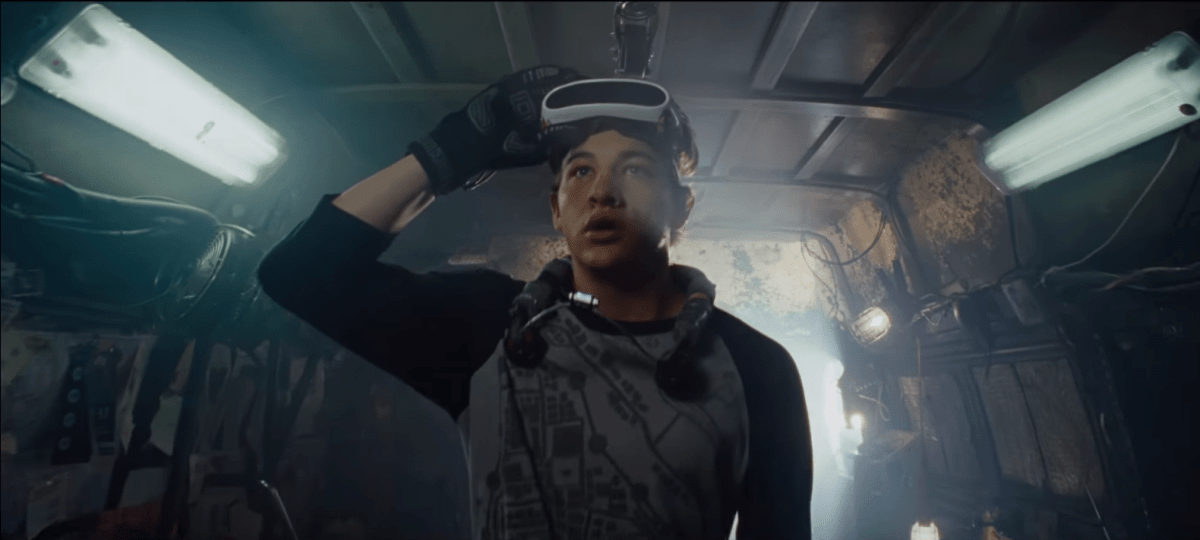
Without spoiling Wade’s journey in Ready Player One, his OASIS metaverse is both a wondrous fantasy and a dystopian failure. It’s where he makes his deepest friendships and most hated enemies. And he discovers a world laden with unrest and claims to power, much like ours today. If we can glean one lesson from building the internet, it’s that technology is not fundamentally just or evil: it merely amplifies the qualities of those who wield it. Like every technology before it, the metaverse will reveal existing societal flaws and new challenges alike. Ultimately, it’s up to us to decide its fate.

Categories
Longform Essays

On the Metaverse: Part I

Wade dons his goggles and haptic gloves, then powers on the system. A loading bar flashes. After a moment, he’s whisked into a new world – vibrant and full of color. All around him, avatars of every shape and size roam about.

“My avatar materialized in front of my locker on the second floor of my high school—the exact spot where I’d been standing when I’d logged out the night before. I glanced up and down the hallway. My virtual surroundings looked almost (but not quite) real. Everything inside the OASIS was beautifully rendered in three dimensions. Unless you pulled focus and stopped to examine your surroundings more closely, it was easy to forget that everything you were seeing was computer-generated.” [1]

In Ernest Cline’s Ready Player One, readers follow Wade Watts into a radical escape from his dystopian surroundings. Stranded in a trailer park outside Oklahoma City, Wade has little hope for success in his physical life. So he turns to the OASIS: a magnificently rendered virtual universe accessed through virtual reality (VR) goggles. In this world, Wade has friends and enemies, weekly routines and weekend excursions. He attends school and earns digital currency through work. And he identifies more with his digital avatar than his physical self. In the absence of a world worth living in, Wade and millions of others turn to the OASIS for freedom.

The OASIS that Wade traverses in Ready Player One is a creative portrayal of the metaverse. While the OASIS itself is fiction, the metaverse is quickly becoming real. We are barreling towards a new state of connectivity where we increasingly identify with our virtual lives. This future lies beyond video calls and social media. It will be spatial, interactive, gamified. More friendly, yet less obsessed with friend requests. At some point in this evolution, we’ll call it the metaverse. Its implications will touch every facet of society.

So what is the metaverse?

Defining the metaverse is hard. The term was first coined in Neal Stephenson’s 1992 novel Snow Crash, describing a virtual urban world where users would “goggle in” to socialize or conduct business. Since then, many authors have created interpretations of the metaverse, including Ready Player One’s OASIS described above.

Like predicting the internet’s growth in its infancy, it’s difficult to characterize a state that doesn’t yet exist. At its simplest, the metaverse is a virtual world containing most functions from our real world, including social interaction, business activity, and entertainment. The metaverse is a future iteration of our current internet: offering mass communication and user generated content in a gamified, visual universe. And like the internet, we will build the metaverse over a long time horizon. Some components will mature before others, leading to a continually evolving state.

Thus, it may be easier to think of a set of characteristics that collectively define the metaverse. As a former Amazon Studios executive and current venture capitalist, Matthew Ball is well versed on interactive and digital media. Ball characterizes the metaverse in seven necessary attributes, summarized below [2]:

  • Persistent: Unlike a single Call of Duty match or Zoom meeting, the metaverse is always “on” – whether or not users are logged in
  • Live: Events in the metaverse occur synchronously for all parties involved, including both large events like concerts and person-to-person interactions
  • No cap on participants: A near-infinite number of users can login and experience an event simultaneously, while retaining a sense of self through a controllable avatar
  • Functional economy: Users can engage in economic transactions with other individuals and businesses, trading both physical and digital goods
  • Universal: Metaverse experiences span both physical and digital worlds, open and closed platforms, and free and premium spaces
  • Interoperability: Just as currency functions as a consistent medium of exchange between two parties engaging in a transaction, the metaverse provides consistency across data, digital items, and content. Users can interact with intellectual property from many origins seamlessly
  • Variety of content: Both individual and commercial creators develop and operate unique experiences, with a wide array of offerings

But just as we must define what the metaverse is, we must define what it isn’t. Misconceptions abound. For one, the metaverse is not only a virtual world or advanced game. While these are important components, virtual worlds have existed for over thirty years [3], most famously in many video games. Massively Multiplayer Online (MMO) games like World of Warcraft and RuneScape popularized the concept in the 2000’s, and Second Life gained a following as a virtual life simulation, complete with a robust economy [4]. While experiences like Second Life will be remembered as early metaverse predecessors, the metaverse concept encompasses far more and requires further advances in telecommunications and computing technology. Virtual worlds are a core component of a functioning metaverse, but aren’t sufficient alone to be defined as a metaverse.

Second, we often associate virtual reality with the metaverse, largely because of pop culture like Ready Player One. After all, Wade’s VR set is his most prized possession, allowing him to escape to a different world. However, this is similar to conflating a phone, tablet, or laptop with the internet; it confuses the medium with the message. As VR adoption increases, it’s likely to be a popular method for accessing the metaverse. But it’s just that: a method.

Lastly, it’s difficult to imagine the sheer scale possible in the metaverse. Thirty years ago, who would think there would be 1.5B websites created, or that over 2B users would watch over 1B hours of YouTube each day? We tend to believe the internet has “been built”, but adoption is still growing rapidly, especially in developing countries. About 53% of the world is online, and another 590,000 users join for the first time each day [5]. Now imagine the speed of software development and the amount of user generated content in a world where nearly 100% of the population has internet access. Metaverse possibilities are even more colossal than what we can imagine.

It’s Time to Build

These massive worlds will have massive economic ramifications. Much like the creation of the internet, the individuals and enterprises that build the metaverse will become the winners of a new economy. The seven largest publicly traded companies, with a combined market cap of over $6.9T, are all core technology companies that benefited from massive growth via computing and the internet. Similarly, the metaverse will mint new giants.

But who might these winners be? Just as the internet’s winners included companies born a generation beforehand (Apple, Microsoft, Oracle), today’s visionaries will capture a corner of the metaverse.

An early front-runner may be a surprise. While Facebook and Google were building their social empires, Epic Games was developing games on its own Unreal Engine, including Gears of War and Unreal Tournament. In 2011, Epic had the idea to combine building gameplay from games like Minecraft and Terraria with the fast paced action of a first person shooter. Six years later, Epic released Fortnite: Save the World in 2017.

The original cooperative game drew minor success, but Epic noticed the industry traction of competitors in a popular new genre of game: Battle Royale. In Battle Royale, players explore a finite map and fight to be the last one remaining. And so Epic quickly developed the game mode that would soon draw hundreds of millions of players – Fortnite Battle Royale.  

Fortnite has achieved unprecedented success in the three years since it was released. Epic doesn’t disclose the number of active monthly players, but with over 350M registered players and over 3.2B gaming hours in April, Fortnite is quite popular [6]. Three factors drive this continued success. First, Fortnite is free to play, providing new players a minimal barrier to entry. Second, like other multiplayer hits, Battle Royale offers evergreen content, providing near infinite replay value. While gamers often tire of single player campaigns with a finite story, Battle Royale offers a match with unpredictable outcomes. In this way, its allure resembles that of sports. And third, Epic consistently releases fresh content. Whether it’s building new island maps, adding new vehicles and weapons, or engineering a synchronous black hole that wipes the game off servers for several days, Epic ensures Fortnite remains an exciting experience.

In recent memory, Fortnite has evolved to become far more than just a game. The game was already Gen-Z’s preferred social platform. In-game concerts by Marshmello (February 2019; 10M unique players) and Travis Scott (April 2020; 27M unique players) cemented this state and opened a realm of possibilities around social networking [7]. Epic is building on this success through the April 2020 launch of Party Royale: a weapon-free map for social activities, concerts, and hanging out [8]. Players can fish, boat, and attend concerts by a lineup of DJ’s including Diplo and Steve Aoki.

Lastly, Epic has miraculously convinced IP owners to allow protected content within Fortnite. Players can suit up as licensed characters from Star Wars, Marvel, Stranger Things, the NFL, the NBA, and more. This catalog is especially impressive given how rarely Disney leases out IP. Through these partnerships, Epic has a strong advantage on interoperability and a variety of content.

While the wider world may just be taking notice, Epic hasn’t been shy about its intentions. In fact, CEO Tim Sweeney has envisioned something larger for quite awhile:

Metaverse Hopefuls

But one company isn’t likely to dominate the metaverse as in Ready Player One; it takes a village. Recently valued at $4B after a round of venture funding in February, Roblox is also well-positioned to capture a stake. Unlike Epic, Roblox serves as a decentralized gaming platform where users can create and monetize their own games through user-generated content (UGC). Roblox has enjoyed tremendous success. Since launching in 2006, the platform has grown to 115M monthly active users and over 2B monthly hours of gameplay [9] [10]. 59% of players are under 13, and over 40% are female. And growth is skyrocketing during the current shelter in place environment. With this momentum, Roblox makes a strong case that the metaverse will be built by users.

Minecraft is another exciting platform. After being acquired by Microsoft in 2014, the game’s user base has grown by 4x. With 126M monthly active users, the game is larger than both Fortnite and Roblox. While its user base continues to skew young, the game has gained traction among adult players as well.

Similar to Roblox, Minecraft does not rely on a single “game” to entertain users – enjoyment stems from exploration and world-building itself. Users have constructed impressive worlds, including – among others – a replica of King’s Landing (Game of Thrones) [11]. And in March, the Reporters without Borders group used Minecraft as the sole setting for its Uncensored Library, a virtual world housing censored texts from countries without freedom of press [12]. Creations like these highlight a key learning. While developing a game users love is great, providing users a credible environment and the tools to build is exponentially more powerful.

Lastly, Nintendo’s intellectual properties and devoted fanbase make it an interesting metaverse contender. Nintendo has been creating games for decades longer than Fortnite, Roblox, and Minecraft and has produced several of the most successful franchises of all time, including Super Mario, Zelda, and Pokémon. However, a recent release has been making waves during the pandemic. Animal Crossing: New Horizons was released on March 20, billed as a peaceful antidote to chaotic news cycles and unending quarantine. The life simulator sold over 13M units in its first 6 weeks and set an all-time record for digital sales of a console game in a month. But the game is more than a wholesome escape. Animal Crossing has become a social phenomenon where users port real life events online due to the pandemic. In game events include:

  • Weddings to replace cancelled real-life ceremonies [13]
  • Graduation ceremonies for law school and engineering students [14]
  • Late night TV shows [15]
  • Artificial intelligence conference, complete with coffee breaks and serendipitous meetings [16]

With credible social experiences like Animal Crossing and Pokémon Go and a wealth of beloved franchises, Nintendo is well-equipped. However, the company has historically built closed systems. Nintendo games can only be played on Nintendo-built consoles, and Nintendo characters rarely leave Nintendo worlds. If Nintendo sets its gaze on the metaverse, expect it to build a private corner, not an interconnected world for the masses.

Sleeping Giants

Envisioning the metaverse through a gaming-first lens feels natural, but doesn’t entirely depict the stakes. Like most advances, an entire stack of technologies will be necessary: server infrastructure, computing hardware, devices, networking, and layers of software and security. Gaming-first companies might build the worlds, but software-first companies will certainly be powerful. The social media era has highlighted the power of network effects and communities, which make it difficult to shake incumbents. Thus, organizations with a large user base and direct access to its consumers will continue to thrive.

Among the giants, Facebook is uniquely positioned to develop metaverse-ready content and hardware. In September 2019, the company launched the beta version of Horizon, characterized as a “virtual reality sandbox universe where you can build your own environments and games, play and socialize with friends or just explore the user-generated landscapes” [17]. The platform operates like a Roblox world-builder with a Wii Sports design, and it is Facebook’s content experiment to pair with its Oculus VR headset. Facebook will have to decide how tightly to integrate Horizon with users’ existing profiles, which might feel intrusive if user data is ported over without explicit consent. But with a much larger market capitalization than the above gaming companies combined, Facebook has the resources to fund its metaverse efforts.

Finally, Microsoft’s quiet success under Satya Nadella’s six year tenure makes it a challenger. The company has defended its position as the primary provider of office software, enhancing collaboration tools and minimizing market share lost to Google Suite. And with Azure cloud revenue still growing at 62% per year, Microsoft is positioning itself for the next generation of work.

Moreover, even before acquiring Minecraft, Microsoft built a massive games business on the success of the Xbox product line. Xbox generations have sold 150M units since the original 2001 launch. And after a series of acquisitions over the last 20 years, Microsoft owns 15 game development studios, including 343 Industries (Halo), Turn 10 Studios (Forza), and Obsidian Entertainment (Fallout: New Vegas). With strong positions in hardware, software, gaming, and cloud infrastructure, Microsoft is a dark horse to capture significant bounty.

The metaverse will have a transformational impact on the way we interact, for both work and leisure. The potential scale is nearly unimaginable and will only grow as internet adoption continues to grow in developed countries. And the opportunity is large enough for dozens of competitors, old and new, to thrive.

Epic Games hopes to get there first, leveraging its Fortnite brand to deliver noncompetitive social experiences as the preferred hangout platform. Minecraft and Roblox are arming their users with the tools for world-building, allowing for creations no company could ever hope to conceive itself. Nintendo is building on its deep IP catalog and riding the social momentum generated by games like Animal Crossing. Tech giants like Facebook and Microsoft are each leveraging their unique strengths and massive pools of capital to dominate the next era of communication and entertainment. With these players and many others vying for control, it will be an interesting battle to observe. And who knows – together, they might just build the next OASIS.


We’ve discussed the metaverse concept and some early leaders who hope to build it. But how will they build it? What are the biggest challenges in the road ahead? And how will COVID-19 and other trends impact our metaverse journey? Check out my next essay, On the Metaverse: Part II.