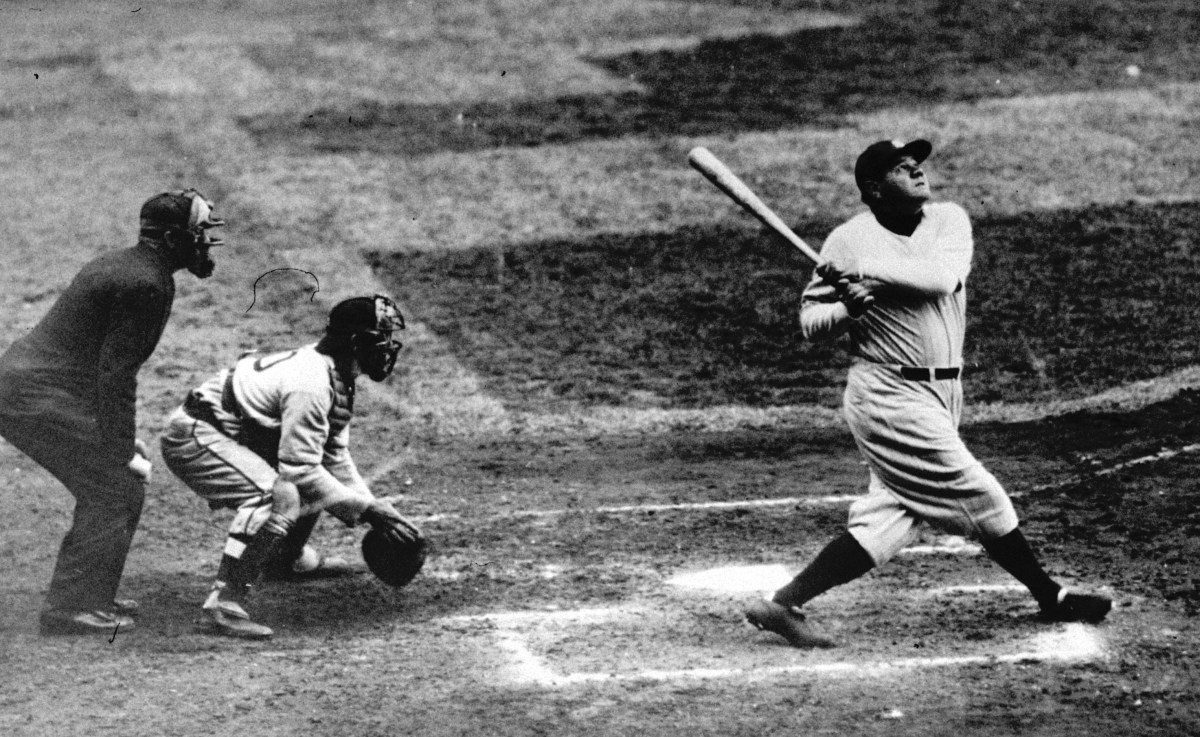
It was March, and a pandemic was beginning to sweep America and the world. Morale was low and misinformation abounded. The economy was reeling. In Major League Baseball, players and coaches wondered if they would get to play. But this scene isn’t 2020; it’s 1918, against the harrowing backdrop of World War I. And the pandemic isn’t COVID-19, it’s the Spanish Flu.
When cases of an unknown virus began to infect soldiers in Fort Riley, Kansas, the world was still focused on the war at hand and paid little attention. This was the landscape as the Boston Red Sox travelled down to Camp Pike in Little Rock, AR for spring training. As two players fell ill with a strange flu-like ailment, a moderately successful pitcher named Babe Ruth got his first chance at the plate. Ruth had never batted higher than 9th in a game before, but that would soon change. He hit five home runs on the day.
“To the immense enjoyment of the soldiers, he drove five balls over the right-field fence. The feat was so unusual that a Boston American headline blared: “Babe Ruth Puts Five Over Fence, Heretofore Unknown to Baseball Fans” [1].
Very little worry was afforded the two sick players as the Spanish Flu was not yet prevalent. Life carried on until May, when Ruth himself battled the same sickness. After a day spent lounging at the beach, he developed a soaring fever, body aches and a throbbing throat – telltale signs of the flu. Ruth spent nearly a week in the hospital. Some thought he was on his deathbed. But he battled back, fought off the illness, and was able to take advantage of his newfound publicity as a hitter. Ruth hit 11 home runs in May and June alone, finishing the war-shortened 1918 season with a batting average of .300. As the world battled a pandemic that would claim nearly 50 million lives, a new titan of baseball was born.
570 years prior, a different pandemic was emerging. The bubonic plague swept across Italy, arriving in ports with travelling sailors and merchants. The situation was dire in Florence, where over ⅔ of the population would eventually succumb. For writer and poet Giovanni Boccaccio, it was especially deadly, as both his father and stepmother soon passed. In a memoir, he sums up the terrible effect of the plague:
What gave the more virulence to this plague, was that, by being communicated from the sick to the healthy, it spread daily, like fire when it comes in contact with large masses of combustibles. Nor was it caught only by conversing with, or coming near the sick, but even by touching their clothes, or anything that they had before touched [2].
Fortunately, Boccaccio was able to flee the city and camp out in the Florentine countryside to wait out the storm. It was here that he penned his most famous work, The Decameron. The collection of novellas is composed of 100 tales by narrators who are attempting to escape the plague by “sheltering in place” – to use the modern word – in the Tuscan countryside, just as Boccaccio did. As a pandemic ravaged much of western Europe, a writer found new creativity.
Much has been said recently about the great works of some of history’s best thinkers while in quarantine. Shakespeare famously wrote King Lear, Macbeth, and Antony and Cleopatra while quarantined in London during a plague outbreak there. John Milton finished Paradise Lost, the epic poem about Satan’s fall from grace, while in quarantine during the Great Plague of 1665 – all while going blind. And perhaps no one can reprise the quarantine accomplishments of Newton. When a bubonic plague outbreak forced him to his family’s farm for 18 months, he made three minor discoveries: light refraction, calculus, and gravity.
We now find ourselves in a similar situation. Geographically bound, we’re forced to remain within the confines of our homes, watching Netflix and reading. We’re all trying to maintain some semblance of a routine, though it’s increasingly hard without the daily customs we’re used to: commuting to the office, seeing coworkers face to face, working out at the gym, grabbing a drink after work. It’s tempting to seek the godlike productivity of some of history’s greats in times like this: If they can do it – so the story goes – why can’t we? For one, many of us are suited to different pursuits of creativity:
incredible achievements while under quarantine:
(@bobvulfov) March 14, 2020
– shakespeare: wrote king lear
– isaac newton: laid the foundations for his laws of motion
– me: invented the peanut butter and jelly taco
In many ways, it’s enough just to focus on “getting through this”. With people affected very differently by the current pandemic, what is a mild inconvenience to some is drastically life-changing to others. Over 22 million Americans have filed claims for unemployment in the last 4 weeks. For comparison, an average 4 week period the past five years has had under 1 million new claims. Many are simply trying to hold onto a job or make ends meet while managing an inconsistent income. And for those that are able to work from home, focus comes difficult. As we are learning, an endless parade of Zoom meetings leaves little room for deep work.
There’s no point in stressing over unattainable goals during times of crisis. To survive is enough. But there are some silver linings, both for individuals and the larger society.
For individuals, this season has offered a rare chance to spend increased time with loved ones. Recent graduates are escaping urban centers and spending more time at home. Parents with small children, while likely stressed and overworked, are getting more time with their kids than usual, especially during the week. Families are enjoying meals together, watching movies, and playing board games. After all, no one has anywhere to go. While this time is sometimes hard to appreciate in the moment, we are likely to see a rosier picture in the rearview.
Additionally, the shift from standard routines provides a rare opportunity to remake habits in a new environment. In his book Atomic Habits, James Clear recounts research on the unfortunate prevalence of heroin addiction among US soldiers during the Vietnam war. By 1971, 35% of soldiers stationed in Vietnam had tried heroin and addiction plagued as many as 20%. The prevailing view was that this heroin use would matriculate back home to the States and become a mass problem, so President Nixon created the Special Action Office of Drug Abuse Prevention to investigate. Their discoveries proved otherwise:
In a finding that completely upended the accepted beliefs about addiction, [Lee] Robins found that when soldiers who had been heroin users returned home, only 5 percent of them became re-addicted within a year, and just 12 percent relapsed within three years. In other words, approximately nine out of ten soldiers who used heroin in Vietnam eliminated their addiction nearly overnight. [3]
Most of us won’t need to break a heroin habit. But when our environment drastically changes, it’s an opportunity to rewire our brains with a different set of cues and structure our lives in a way that makes more sense in the current situation. For those who are able, living and working out of our homes is a perfect chance to do so. There has never been a better time to realign habits around fitness, sleep, reading, or electronics usage. It’s one of the cues that helped me to start writing.
There’s also reason to be optimistic that despite the chaos, the progress of startups and new technology will resume as normal after the storm.
Looking back at Babe Ruth’s time, the years during the Spanish Flu pandemic weren’t economically great. After all, the world was still reeling from the first World War. While the market rebounded as the war subsided, much of the world would take time to recover. On paper, this wasn’t the ideal age for entrepreneurship. But take a look at a short list of companies that emerged within the US during the height of the pandemic, still recognizable today:
- RCA Corporation (1919, created within GE)
- AIG (1919)
- Ally Financial (1919, created within General Motors)
- AMC Theatres (1920)
- Occidental Petroleum (1920)
- Perdue Farms (1920)
- Rubbermaid (1920)
- Eddie Bauer (1920)
Despite the war and pestilence around them, each of these brands grew into a sustainable business, survived the Great Depression, and prospered throughout the 20th century to remain relevant to businesses and consumers today. World war and a pandemic could not choke out entrepreneurial spirit.
Companies formed during the Spanish Flu aren’t an outlier. During downturns, it’s common for new enterprises that survive the immediate storm to thrive afterwards. According to a 2009 Kaufman study on the impact of bear markets on entrepreneurship, 57% of Fortune 500 companies were formed during bear markets or recessions, including the Great Depression, the bear market of 1981-1982, and the Dot Com Crash of the early 2000’s [4] [5]. The study was summarized in three findings:
- Recessions and bear markets, while they bring pain and often lead to short-term declines in business formation, do not appear to have a significantly negative impact on the formation and survival of new businesses.
- Well-over half of the companies on the 2009 Fortune 500 list, and just under half of the 2008 Inc. list, began during a recession or bear market. We also find that the general pattern of founding years and decades can help tell a story about larger economic trends.
- Job creation from startups is much less volatile and sensitive to downturns than job creation in the entire economy.
It isn’t immediately evident why companies born in recessions often thrive well into the future. The reasons are likely varied and interwoven. Founder persistence. Establishment of a risk-averse culture. Antifragility. Market consolidation. And even aspects of survivorship bias. The potential correlations are limitless. However, an exact understanding of this pattern isn’t necessary to understand its impact. Sometimes, tough markets produce the world’s greatest enterprises.
This trend continues into the 2000’s with some of the technology giants of today. Founded in 1998, Google was trying to establish a footing in the increasingly competitive field of search during the Dot Com Crash. Funding dried up and valuations plummeted during an especially poor time for startups. When competitors couldn’t make it through intact, the market consolidated, hiring became easier, and funding was more prevalent. Google grew to obtain a much larger market share of search than before. The same can be said of eBay and Amazon, who each thrived after the Dot Com Crash with stronger focus and thinner competition.
We can expect tough times ahead for the world’s new companies and markets as a whole. Similar to individuals, many organizations are facing a reality previously unimaginable: revenue going to zero nearly overnight. And unfortunately, there will be economic casualties. However, if history is any lesson, we as a society will emerge on the other side with experience and the capability to develop more robust systems for future pandemics.
The COVID-19 pandemic is no candyland. There is real suffering and there are real risks threatening the global order and long term prosperity of society. But looking back at history can help us keep our current situation in perspective. Similar pandemics and tough circumstances have wrought upon us some of our greatest innovations from individuals and organizations alike. Some trends will be reversed, but many will continue unabated. New people, organizations, and ideas will emerge, ‘forged through fire’. Even in difficult times with great uncertainty, there are always silver linings.
A big thanks to Web Smith and 2PM for featuring this essay in their Monday Letter. You can view the feature here.
 John Stone
3 replies on “On Pandemics and Silver Linings”
Thanks for this well researched and well-written uplifting blog during this difficult time!
LikeLike
Well thought and well written!
LikeLike
This reminds us of the light at the end of the tunnel…Uncle Reamer & I Loved your insight..
LikeLike